Showing posts with label Gaelen Brown. Show all posts

Monday, 25 March 2019

The First Compost Heated Greenhouse


In his book Green Wizardry, John Michael Greer argues that we would do well to look back to the work accomplished in the 1970s regarding appropriate technology and sustainable living.

In particular, he often mentions the innovative projects of The New Alchemists, who founded a research institute in Cape Cod, Massachusetts at the height of the sixties counterculture in 1969, and published the results of their projects and experiments in journals throughout the 70s and 80s.

The New Alchemists collaborated with thinkers like the economist E.F.Schumacher and the technologist Buckminster Fuller, mixing together technology and counterculture values in an attempt to re-think how the systems that support human life and culture might be balanced with the health of the ecosystems that make our existence possible.

Experiments were conducted with solar energy, wind power, their fully integrated 'bioshelter' on P.E.I., and aquaculture: Greer notes that "the New Alchemy Institute is the reason you've heard of tilapia; that tasty, nutritious and quick-maturing fish was the species they chose for their pioneering work..."
Conversations inside a geodesic dome

The New Alchemy Institute came to a close in 1991, a year when climate change was rapidly rising into public consciousness, leading up to the Kyoto Protocol in 1992.

(I still remember painting an image of the Earth on a t-shirt in Grade 5, and painting 1 9 9 1 below the globe, in honor of Earth Day that year. I was picked out to make a little speech about environmentalism at a local celebration of the day, at Assiniboia Downs, the city's horse racing establishment. I'd really like to know what I managed to write for that, and I think a cassette tape might remain of it, I remember recording some practice sessions, and of the event itself.)

The NAI Greenhouse Project
My ears perked up when I read that the New Alchemists had commissioned  a compost-heated greenhouse project in the early 1980s, in Gaelen Brown's The Compost-Powered Water Heater.

The designer, Bruce Fulford, took the concept of harvesting the heat generated by the composting process in a very different direction than compost heat systems of the French organic farmer and forester Jean Pain in the 1970s.

Whereas Jean Pain had set up compost piles of shredded brushwood outdoors, circulating water through piping that was coiled through the compost to collect heat, Bruce Fulford worked in a climate much colder than the south of France, and attempted to keep the composting process inside the structure the compost was being used to heat.

This of course allows for a lot of the heat that would normally dissipate into the air to be retained in the building, but at the same time creates other problems, not least that the gases generated by compost are also kept within the structure.

Bruce Fulford
The design that Fulford came up with is to my eyes really elegant, balancing human needs with the needs of the ecosystems around us, with just a small amount of modern technology to make human life a little easier than by traditional methods, which is I guess is the key to the New Alchemist's style.

I remember the farmer and writer Joel Salatin saying something along these lines, that he tries to follow nature's patterns as closely as possible he moves his cattle through various pastures (and as he moves his chickens behind them in a mobile coop), but that it was one piece of modern technology that made the whole soil-regenerating process possible, his light-weight portable electric fences.

The trial greenhouse was apparently not without its flaws, but I think the details of this experiment were  important, and have been perfected over time in some larger, commercial-scale systems that I think could have real promise, especially in mid-sized agricultural operations. I also found examining the simpler, original system made it easier to grasp the functioning of the larger systems.

Part of an Agrilab System at Jasper Hills Farm.
I'll look at the details of larger systems developed by Agrilab Technologies in a later blog post, but basically any farm that generates a substantial amount of manure and other compostable materials can use these to generate a fair amount of heat and energy.

This saves them on fuel costs and reduces their carbon emissions, while at the same time produces a lot of high-grade compost that used on the farm or sold, further improving the economics of the operations. Some of the dairy farms in Vermont where these systems have been installed use the compost as bedding for their cattle, which reduces the amount of straw they have to buy and apparently is good for the health of the cows. One of these dairy farms also uses the heat from the compost to warm bio-gas generators, for use in their cheese making facilities, again further reducing fuel costs and the amount of fossil fuels combusted.

It's a virtuous circle, as the more compost that can be integrated into degraded soils might increase the amount of carbon held in the soil rather than in the atmosphere. And if anyone is thinking that there may be energy shortages in the upcoming decades, it could be a help to food security and to rural economies if farms had the ability to generate heat and fuel on-site. Add to that adding red seaweed to cattle feed to dramatically reduce methane emissions and adding biochar to the compost, I'm wondering if cattle farms could go from being major carbon emitters to becoming carbon negative, all the while producing food and restoring soils?
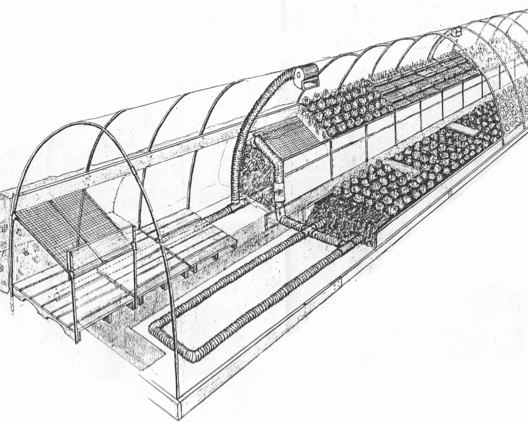


So, going back to the basics of the New Alchemist's greenhouse project: they began with orienting one long side of this 576 sq. ft. greenhouse towards the south (the side facing us in this drawing, that touches the ground right beside the lower garden beds) to collect as much solar thermal energy as possible in the greenhouse.

The compost bins were built (along the back half, opening on the north side of the structure. This drawing shows a cross-section of them empty and of them filled, I've labelled them both "A".)

The bins held 25 cubic yards of compost, and were built with insulated outdoor hatches, so that the compost feedstock and the finished humus could be added/removed from outside the greenhouse. In the first year of operation, NAI reported generating 100 tons of finished compost.

To generate heat, the thermophilic bacteria in compost needs access to oxygen. If the piles become to dense or water-logged, anaerobic bacteria take over and heat production comes to a halt. One way to aerate the piles is to turn the materials, by hand or mechanically. Or you can build up materials, like Jean Pain's shredded brushwood piles or with straw, to have enough interstitial air pockets for air to passively move through the piles. Also, the air can also be pushed through or drawn through by fans, which is what Fulford decided on for this design, and then used that warmed air being drawn through the compost to heat the greenhouse.

Blower fans were located at the top of greenhouse, and moved air through ducts down along north wall of the greenhouse, to underneath the compost piles. Secondary fans were located above the compost chambers to draw the hot, steamy, CO2 rich air up through the compost, and move it into ducts located in the soil below the greenhouse plants.

This lower greenhouse beds, labelled "biofiltration beds" in this diagram, are the most interesting part of the greenhouse to me, as they are used to filter the gases being produced by the compost bacteria.

Compost piles in the open-air don't create a lot of strong odors unless the pile becomes anaerobic, but composting in enclosed spaces is, apparently, a different story. The nitrogen content of the compost feedstock, in particular manure and urine, gets forced out as ammonia gas (NH3) as the pile begins to heat up.

Ammonia gas is irritating to the eyes and lungs, harmful to our health in high enough concentrations, and "will damage plant leaf tissue in concentrations as low as 10ppm." In greenhouse experiments where ammonia gas was not scrubbed from compost exhaust, the plants "suffered chemical burns." (p110, Brown.)

However, Fulford found that if a few inches of mature compost and soil are layered over top of the compost exhaust plenums, these problems were transformed into very beneficial growing conditions for greenhouse plants. As the ammonia (NH3) mixed with the moisture in the exhaust pipe and then in the compost/soil 'biofilter',  it changed into ammonium (NH4+) and remained within the soil, while allowing the CO2 to pass through into the greenhouse air, perfect for the plants to respire.

The author, Gaelen Brown, notes that greenhouses often invest in expensive air exchange systems to increase CO2 levels within greenhouse, noting that compost exhaust is one way carbon dioxide can be supplied through biological means.

The benefits don't end there, however: that ammonium (NH4+) is a means of supplying nitrogen to the garden beds. Some of it is taken up directly by plant root hairs, while the bulk of it transformed into "plant usable" nitrates (NO3-) by the nitrifying bacteria who feed on the high carbon content of the bio-filter.

The layer of compost and soil that served as a bio-filter did require maintenance, especially relating to moisture levels, if it dried-out or became to wet, its performance as a filter lessened.

The addition of earthworms and manure worms helped (as usual!), by creating channels in the soil and though the transformations performed by their digestive systems. Also, the inclusion of several types of clays were found to help increase the amount of nitrogen the biofilter could absorb.

When the biofilter became fully saturated with nitrogen, these soils and mature compost could be removed from the greenhouse and applied as a nitrogen-rich fertilizing ammendment to other soils, another way that we can reduce the amount of synthetic nitrogen fertilizer that we use annually.

NAI Grounds
The blower fans were set at a low speed, and were controlled by a photo sensor switch so that they would only operate in the daytime, to avoid drying out the compost excessively, and also to provide CO2 to the plants when they could best make use of it in photosynthesis. The fans were also controlled with a thermostat, so that if the temperature in the greenhouse dropped below 40F during the night, the fans would turn on, and draw heat from the compost to raise up the greenhouse air temperatures.

They greenhouse experiment was taken through the winter in Vermont, and they did have some problems with how they constructed the shell of the greenhouse. It allowed a lot of heat to escape, and apparently they also failed to add new compost feedstocks at a rate to keep the temperatures up.

That said, they managed to keep the greenhouse above freezing for most of the winter, and on some especially cold nights where greenhouse air temps hovered around freezing, the heat retained in the garden beds weathered them over, even the lettuce and parsley crops managed to get through the cold nights unharmed.

In general, Fulford recorded this project to be 23 - 35F (13 - 19C) warmer than outside air, a differential which could be greatly improved with a better greenhouse construction, but which proved to be adequate even as it was.


Brown doesn't mention in his book what happened to the greenhouse after the trial period was over, and the report was written up. I notice in this picture, which I think is of this same greenhouse, I don't see any blower fans mounted along the apex, I wonder if the New Alchemists took out the apparatus and just used it as a regular, season-extending greenhouse after the experiment came to a close?

Conan Eaton's Compost System
Whatever the case, this project was one of the few undertakings that kept compost heat recovery technology alive in the decades after Jean Pain's death. These basics, of using fans to aerate indoor compost piles, using that air instead of water as the heat transfer medium, and using a biofilter to scrub the exhaust gases have been incorporated into larger, much more reliable designs, which I want to look at in the next post in this series, along with some other low-tech, DIY systems that I really appreciate as well.

I would also like to keep looking into the other experiments of the New Alchemy Institute. In Green Wizardry, Greer includes a lot of exercises for the reader & 'green wizard' aspirant, and one of them is to go the local used bookshops, and see what copies of 1970s appropriate technology books might be found. I got a copy of Tomorrow is Our Permanent Address by two of the founding New Alchemists, John Todd & Nancy Jack Todd, I hope to learn more about their ideas on integrated bio-shelters.


Saturday, 5 January 2019

Compost Water Heater: Tabletop Model


Around issues like climate change or economic collapses, I've been aiming to balance out my reading and media-intake. I'm moving away somewhat from general overviews of the predicaments our society finds itself tangled within, to focus more on specific technologies and practices that seem to hold some promise towards making ourselves more resilient to these predicaments, or even being regenerative to the ecological, economic, and social relationships on which we rely.

The idea was to find a series of these technologies, simple or complex, and dial-in on each in detail, one by one, learning about how they work, and how they could possibly be put into practice. And aside from only reading about them I'm trying to get in the habit of finding some way to work with the principles & ideas involved in some sort of physical way, even if it is only making a model or a drawing.

I think that can be valuable in a few different ways. It definitely keeps me thinking about a technology/practice for longer than I probably would've been just reading about it. Trying to implement aspects of an idea in the real world brings up questions that I might have otherwise passed over, sending me back to the books with new questions in mind. As with so many endeavors, the more energy you invest into a subject, from a variety of angles, the more inherently interesting & meaningful it becomes to you.

Not only that, but I think engaging in a physical project sends a signal deeper into our minds that we are serious about an idea: somehow it roots our intentions and shifting thoughts into our daily, physical life. The object itself, sitting around in your living space keeps you coming back to the idea, even if you leave off for a number of months. Objects can become display pieces and act as social beacons to start up discussions with others, maybe sparking an idea in the mind of just the right person.

Materials collected up for a solar oven
A series of these types of projects can initiate a sort of scavenger hunt and leave it running as a background process in your life. The contents of dumpsters, thrift stores, and your parents' garage become much more interesting, as possible sources of cheap supplies to investigate ecotechnic principles.

I think this might be the greatest benefit: building resourcefulness into ones habits, in a way I've always admired in people with a crafty, handy or artistic bent. In times of increasing scarcity, precarity and austerity, I think resourcefulness will be the quality most often called on, as, in Warren Johnson's phrase, we muddle towards frugality.

* * * * *

Best for this are the skills that can be employed as useful parts of our lives, right now: backyard (or front-yard) gardens and clotheslines in the summer, food storage techniques, bicycle repair, sewing and mending, that sort of thing. They can reduce waste right away, increase our skillfulness, and serve as examples, puncturing the optical veneer of consumerism, populating our cities with hints of some simpler ways of living.

Other technologies can be harder to get involved with, especially if one has limited funds or a lack of land or structures to experiment on. Some are entirely out of reach: too expensive, too difficult, too large scale, not currently practical. But there are often ways to break down a resilient technology into aspects that allow one to get at least a little experience in it. For example, a person interested in natural building, once they've done some reading and watched through some videos, might try out making some small batches of natural plasters, maybe they could be worked into a display piece, or maybe take on a small project like a dog house.

These are changing times, and many people who are concerned with the environment and the economy can feel like they are caught between between two worlds, with full commitments within the status quo, and at the same time feeling a pressure and a pull towards a different way of living. I don't see the tension abating any time soon. But, for those who aren't well positioned to make a dramatic leap towards resilience, I think we can engage some of our free time in imagining and experimenting with specifics of the world we'd like to see. At the very least it might bring some seeds of ideas forwards into times when they'll be needed.

* * * * *

Reading up on compost water heaters, I thought there was no way to make a project for the subject. These are fairly large projects: even the smaller ones outlined in this book require 40 cubic yards of shredded brushwood + sawdust + manure to compost, with 300ft of pipe coiled within the pile to collect heat, connected to some sort of means to radiate the heat indoors, whether in a concrete floor, the soil of a greenhouse bed, or a cast iron radiator.

It dawned on me that it might be possible to make a working model. It might capture peoples' imagination if they could see a garbage bin of compost heating up small slab of concrete, especially if they could feel the warmth of the concrete with their own hands, maybe there would be available little aquarium pumps that could circulate the water through the model. This could simplify these systems down to some basic components for people attending a presentation, so they could see a whole system at a glance in small scale.


Here are the pieces of the model and some of the real world analogues:


Heat Collecting Coil: For the model, I wrapped the tubing around a wire cylinder, actually for storing coffee K-cup pods, from the dollar store. In the larger systems, they coil 3/4" - 1" polyethylene or PEX pipe within a large compost pile.


Pump: The heat transfer medium, in this case water, has to move through the hot compost, to the area that is to be heated and back again. I found this little pump that I think is for creating a small fountain in an aquarium.

In the larger system, Brown recommends a 1/8 HP circulator pump, which are very common, used often in hot water heating sytems and for hot water recirculating lines. These pumps can also include flow restrictors, so that one can set how fast the water is moving through the tubing, which is helpful, as too much cool water being cycled back in to the compost pile too quickly can stress the compost microbes.

1/8 HP Circulator Pump

Hot Water Storage Tank: I was a little unsure of why water tanks were added to these systems. The book mentions that they are useful for hot washing water. I wondered too if maybe they simply added more water to the system, and increased the amount of heat energy that was held within the building at any given time?


To me that sets up two other problems. First, if you're going to be drawing water from the system, then you have to set it up so that it fills automatically from another point, and adding too much cool water too quickly can shock the microbes in the compost pile.

Second, if you are going to be spraying the water, unless the water maintains at (I believe) a temperature around 60C/140F, you can risk Legionella bacteria growing in the tank and becoming air-borne when you use the water, which can cause a deadly type of pneumonia. Compost temperatures can get to 140F and well beyond, but from what I read they also drop to 120F quite often.

I included it in the model anyway, as I think it does increase the amount of heat stored in the system, and it was an easy place to include a thermometer to measure the temperature of the water coming out from the pump.


Concrete Slab: Once the compost pile heats up the water and the water is transferred, you need some way of radiating the heat into the space you've chosen. There are a range of options. Some people have water run into old fashioned cast iron radiators. Others have used it to preheat the water going to their hot water tank. The most common seems to be to run it through PEX pipe that is specifically made to radiate out heat, and to either run this radiant PEX through a concrete slab, or directly through the soil of a greenhouse bed. There are also ways to run it between the joists of a floor.

For the model I choose a concrete slab. Like in a regular radiant slab, I lined the underside of the slab with insulation, so that the heat will radiate upwards. I made a little wire grid to tie the tubing to, then filled the box with cement. I included some powdered biochar into the cement mix, just to include the idea of sequestering some carbon into building materials like concrete. I embedded a thermometer in the concrete to measure the heat transferred into the slab.


Compost Pile: I thought the model would have the most visceral impact if people could feel the warm concrete slab, sitting right beside a container of hot compost. I tried at first a container inside a ceramic flower, but it wasn't a large enough mass of compost to really heat up, so I took an old garbage bin, drilled in air holes and made a inner cylinder out of chicken wire, so that the compost could stay aerated from all sides. I layered in straw to make interstitial air pockets throughout.

It was winter, so I had a problem of how to keep the compost from freezing, so that I could see if it would heat to adequate temperatures. I wheeled the bin down into a corner of the parkade beneath my apartment building, and zip-tied the lid down so that security couldn't check its contents.

It did get hot pretty quickly, getting up to 130F/55C in a few days. The stem of the thermometer was hot to the touch when it was pulled from the bin. It did however smell horribly & powerfully filled up a section of the parkade, I'm very surprised I didn't get in trouble for that! They say that compost, once it is oxygenated and thermophilic bacteria is generating heat, is fairly odourless, but to that should be added the caveat that it be in the open air. I've read since that in the early phases of a pile, at lot of nitrogen gases (ammonia, etc) is pushed out of the mass.

I wheeled it in the middle of the night to the service elevator and back out to my balcony, to freeze until spring. If I ever set this up for demonstration, I think it would probably better to get a bucket of water to drop the heating coil into, adding an immersion circulator to keep some water at a constant temperature common in a compost pile, 120F or so.

* * * * *

Those are the basic components of a compost-powered water heater system: the compost itself, pipe coiled within it, a pump, a flow-restricting device, thermometers at various points, and something to radiate heat within the space you want to remain warm.

For the next post on this topic, I'd like to look at another one of the early innovative projects in compost heat recovery, the experimental compost-heated greenhouse set up by the New Alchemists in Massachusetts in the early 1980s.

It had an obvious advantage over Jean Pain systems for colder climates, in that the compost was kept indoors, within the structure that was to be heated, so that all that heat from the compost pile was kept from being directly dissipated into the open air. However, this adds the problem of keeping all the gasses & odours produced by compost within the building as well.

The solutions they worked out, including air instead of water as the heat transfer fluid, have been perfected in some contemporary projects that seem like they could have a place within the appropriate technology framework & help increase the resilience of moderate-sized agricultural operations, especially those that keep livestock. They produce heat that can be used in a variety of ways, reduce bedding costs, process wastes, and return nutrients into the soil.

Two New Alchemists scamper across a geodesic dome.


Tuesday, 13 November 2018

The Compost-Powered Water Heater: An Early System


A few years ago I had the idea to try to learn as much as I could about sustainable & resilient practices as I could.

I was not well set up to learn about these things. I've never known much about any kind of technology. I've always been a renter of rooms & apartments, and never owned any property to experiment on, or land to grow food on. I also didn't have much of a science background to draw on for understanding.

So, my idea was to try to find good books that would cover in detail some specific ecological technology or practice, and build up from there, one at a time.

One book that kept showing up in my Amazon recommendations was Gaelan Brown's The Compost-Powered Water Heater.

Before that, I had looked into biochar stoves, (which produce heat while also making a kind of charcoal that can be used as building material or added to the soil as an amendment, either way in effect drawing down carbon from the atmosphere and sequestering it into our constructions or into the soil.)

Then it was composting toilet systems, which use the heat generated by the composting process to eliminate the pathogens in our wastes, and then decompose them into humus, which can be incorporated back into soils, to re-incorporate nutrients and increase fertility, and possibly increase the overall carbon content of our planet's soils.

So compost-powered water heaters seemed like a progression on the theme: if the composting process generates a fair amount of heat, normally dissipated into the surrounding air, is there a way to collect some of that energy and put it to use, replacing some fossil fuel combustion, at the same time making more compost?

* * * * *

So, this series of posts will be mostly a book report on Gaelan Brown's compact & useful volume, augmented with information from some of the many youtube videos that people have made of their compost heat recovery projects.

I would like to dive right into the systems that Brown installed with the Compost Power Network at the time of the book's publication, but I wonder if it wouldn't be better to start with the two historical experimental projects described in the book, from 1970s France and 1980s Cape Cod, Massachusetts: these two early systems really sketched out the full potentials for the systems that evolved from their trials, the first type relying on circulating water to draw warmth from compost piles, and the second based on air pulled through hot compost, to supply heat to greenhouse beds & other applications.

* * * * *

For many sustainable technologies, there often seems to be some independent-minded tinkerer at the outset, who saw the potentials of some avenue of development, and then applied themselves to working on the technology & to promoting the possibilities of that application to the world at large.

For compost heat recovery, that pioneer has to have been Jean Pain, the Swiss-born farmer and forester, who derived an astonishing range of energy streams from piles of decomposing woodchips.

Jean Pain had an organic farm in Southern France, who also worked as a forester. As a part of a program of the French government to help prevent fires, Pain was paid to clear brushwood from the woods nearby his farm. All this excess brushwood at his disposal, Pain wondered if he could make compost of it for his farm.

J. Pain & Wood Shredder
Compost requires oxygen, and regular wood chippers make wood-chips that become matted-down and water-logged. So Pain developed a chipper that shredded brushwood, creating a stringy texture that allows for oxygen to permeate all areas of a compost pile. (Pain's wood shredders are available in France to this day.)

When Pain had achieved a consistency of woodchip that allowed for oxygen to circulate through the pile without requiring the pile to be turned (while at the same time retaining enough moisture for the compost bacteria to remain active) he experimented with various ways of arranging his compost piles.


In the end, Pain settled on coiling water pipe throughout a cylindrical pile, circulating water through to absorb the warmth generated by the compost pile.

From his fairly large compost piles, Pain was able to produce around 18 months of hot water (140F) for all the domestic needs of his farmhouse. (This was in the temperate climate of Southern France. Later, Brown outlines the changes the Compost Power Network found essential for making these systems work in colder North American regions.)

At the centre of these piles, Pain placed a steel tank for 'biogas' production, so that the heat generated from the aerobic, thermophilic woodchip compost could support the anaerobic generation of combustible methane/natural gas.

For those unfamiliar with the biogas process, I think it can seem at first a little counter-intuitive: aren't we trying to reduce the production of methane, from landfills and the inner fermentation chambers of cattle and to minimize our combustion of natural gas? I'll try to outline the basics of biogas production here, as far as I understand it.

When we pile up organic materials, like food scraps, lawn clippings, wood chips, etc. and ensure that the materials get enough oxygen (by turning the piles, or by ensuring that air can flow through the pile, passively or by use of a fan) then oxygen-loving thermophilic bacteria come to dominate the pile, and the process largely avoids producing methane, which is good, as methane is about 30 times as potent a greenhouse gas as is carbon dioxide.

If, however, you take some of that organic material and let it decompose in the absence of oxygen, anaerobically, you can produce your own methane, basically the same substance us Manitobans often have piped into our furnaces and hot water tanks. So, in Jean Pain's system, he would take some of the partially decomposed woodchips and put them in the water-filled steel tank within his pile. The anaerobic bacteria need warm water, around 100F, which the warmth of the piles produces pretty perfectly, and would produce a steady stream of biogas for around 5 months, before the tanks would need to be refilled.

Of course, if you collect this methane/biogas, then it isn't being released into the atmosphere as a greenhouse gas. Pain piped a hose from the top of the steel tank to a series of series of tractor tire inner tube. Pretty ingeniously, the filled tire tubes provided the pressure to supply his oven with biogas for cooking. Pain also converted his vehicles and farm equipment to run off compressed natural gas, and set up a generator to produce his electricity from the biogas as well.

In terms of climate change effects, biogas/methane/natural gas (CH4, a compound of carbon and hydrogen) when burned produces carbon dioxide and water (CO2 and H2O). When it is fossil-fuel based natural gas we are burning, we are taking carbon that was deep within the ground and increasing the net amount of carbon in the atmosphere.

But when we combust biogas, the carbon we are releasing is the same carbon drawn from the air by plants & trees we are decomposing, so the process is likely carbon-neutral, so long as the land is regenerating this biomass that we've removed, drawing a similar amount of carbon dioxide down once again. Pain was for the most not cutting down mature trees, he (I gather) collecting up fallen wood, pruning, and clearing away new growth where it was coming in too dense, for fire-smarting purposes, and not returning to that woodland for several years, no clear-cutting involved.

And finally, in addition to the hot water, cooking fuel, vehicle fuel, and electricity he was deriving from his compost & biogas piles, Pain attempted to derive warm air for a greenhouse, but running stovepipe from building, through the pile and back again, with the difference between the cooler and warmer air setting up a convection current to circulate the heat.

Not sure what he was collecting here, but looks interesting.

Asides from the various techniques Jean Pain worked out for compost heat recovery, Gaelen Brown emphasizes two interesting claims that Pain made about his systems, that seem to have been supported by further research:
  1. More energy can be derived from composting a pile of woodchips than from burning it.

    Brown says he was told by many "seemingly knowledgeable people, including college professors and engineers" that this was impossible. However, the experiments he carried out with the Compost Power Network "at least partially validated Jean Pain's claim in this regard."

    He gives some calculations in the book, comparing the BTUs generated by composting 20 cubic yards of woodchips and by burning that amount in a woodstove, and finds that they give very similar outputs, though one process leaves behind finished compost to fertilize the soil, while the other process leaves behind ash.

    "[M]ore research is underway, but in a nutshell: Microbial respiration and digestion seem to be more energy-abundant processes than combustion. Microbes are more efficient at turning food into energy than is a woodstove. That should not be hard to believe, in my opinion." (Brown, 14)
  2. Nitrogen-rich compost can be made from composting carbon-rich woody materials.

    Composters usually aim for a balance of carbon and nitrogen in a pile. Carbon provides the food-energy for bacteria, while the nitrogen provides bacteria the building-blocks they need to compose their cellular structures. The goal is usually somewhere around 25-30 parts of carbon to 1 part nitrogen.

    Woodchips have something like a 400:1 carbon-to-nitrogen ratio, and Pain used only shredded brushwood in his piles, without adding any food scraps, manure, urine, etc. And yet he felt the finished compost had good levels of nitrogen in it. How was this possible?

    Pain hired Belgian soil scientists to test the humus produced from his piles, and apparently they found his claim to be correct. The idea Jean Pain and others after him have had, is that "the aerobic respiration of the microbes composting a purely woody material actually pulls in nitrogen from the air and fixes it into the humus." (Brown, 21)

    This claim is intriguing. As I understand it, the vast majority of the nitrogen in our food system is synthetic, created by the energy intensive Haber-Bosch process, which uses high temperatures and high pressures to fix nitrogen from the air into fertilizer.

    The process was a key to feeding the population growth of the 'Green Revolution'; apparently 80% of the nitrogen in our bodies was created by this process. (Michael Pollan's The Omnivore's Dilemma has a fascinating section on this discovery and on the protean, brilliant, dark character of the German chemist Fritz Haber, who was also forerunner in the creation of chemical warfare.)

    But, synthetic nitrogen requires a lot of fossil fuels to produce and emits a lot of GHG, so many wonder about the long-term sustainability of this elemental process in the way we feed ourselves. Much has been said about the ability of legume plants to fix nitrogen in the soil. Could the microbial respiration of thermophilic bacteria feeding on decomposing wood be another organic method of transferring nitrogen from the air to the ground?
*  *  *  *  *

Pain died young, before his time, passing away in 1981 from cancer at 51 years of age. His family established the Jean Pain Institute to conduct research & education programs, and to promote and refine the innovations Pain developed.

Very little was made of Pain's work over the 80's and 90's. It took until the 2000's for permaculture practitioners and others involved in sustainability & alternative energy to renew an interest in his work.

One of the few people who kept this avenue of appropriate technology alive in the intervening decades was Bruce Fulford, who designed an experimental compost-heated greenhouse, as a part of the New Alchemy Institute, on Cape Cod, MA.

I'll make that project the subject of my next post on compost heat recovery systems. The New Alchemy greenhouse is interesting, as the greenhouse operated in a colder climate than Pain's, and kept the composting materials indoors, within the building that required the heat from the compost.  And instead of coiled water pipes within the compost pile, Fulford used blown air as the heat transfer medium. This has advantages, with much less heat loss, but with the gases produced by compost having to be dealt with, in very clever ways that increase the sustainability of the operation.

Jean Pain Committee International, Belgium
*  *  *  *  *


If anyone is interested in more youtube videos on the subject...

- Gaelen Brown lays out pretty much all of the content he has included in his book, for this Living Web Farms video: https://www.youtube.com/watch?v=cvMi6hgfcnw&t=136s

- A German documentary made during Jean Pain's lifetime. I've read people refer to this as being 'low-quality', but I personally love the historical quality of the film. Like the old CBC documentaries, I think the rough quality of the production gives one a better feel for how things were back then.
Part One: https://www.youtube.com/watch?v=JHRvwNJRNag&t=54s
Part Two: https://www.youtube.com/watch?v=zGCj7NA0OIs


Biochar Woks, Cooking, Collapse

I came back to my home city about ten years ago, after having lived for a few years up north in the Yukon. I took a culinary arts course ...